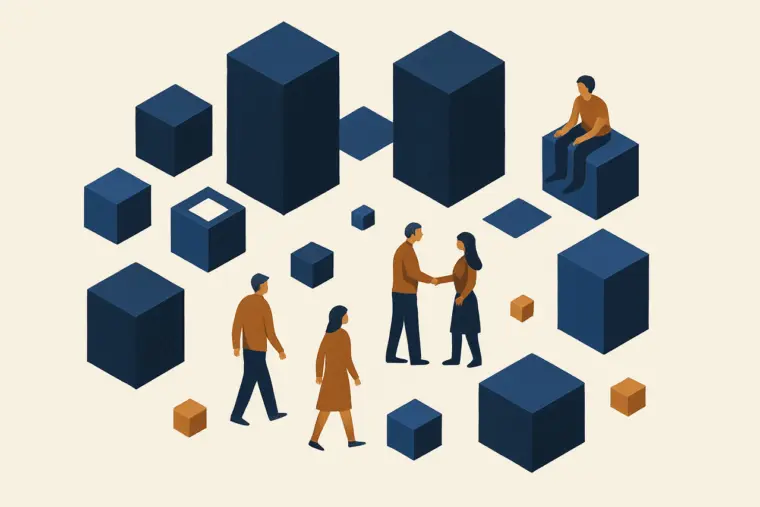
Think of where, in your week, you encounter people who are neither family nor colleagues. The barista you chat with, the regulars at the gym, the neighbours at the park, the strangers at the library table. These encounters are easy to overlook precisely because they are so ordinary. Yet a substantial line of social thought holds that they are anything but trivial — that the places where they happen are a kind of social infrastructure, and that their erosion is one of the quieter problems of our time.
These places have a name: third places. Understanding the concept clarifies a feeling many people have without quite articulating it — that everyday connection has become harder to come by, and that something in the built environment of modern life is partly to blame.
The concept, defined
The term “third place” was popularised by the American sociologist Ray Oldenburg, who set it against the “first place” of home and the “second place” of work. A third place is somewhere else entirely: an informal public setting where people gather by choice, linger, and talk. Cafés, pubs, barbershops, libraries, parks, places of worship, community centres and corner shops are the classic examples.
Oldenburg argued that genuine third places share certain qualities. They are neutral ground, where no one is host and people come and go freely. They are levellers, where status outside matters little. Conversation is the main activity. They are accessible and accommodating, often within walking distance, and they have “regulars” who set a welcoming tone. Above all, the mood is playful rather than purposeful — you go not to accomplish a task but simply to be there. Our society and culture coverage returns frequently to how such spaces shape collective life.
What such places produce is a specific and underrated good: weak ties. These are the loose, low-stakes connections with acquaintances rather than intimates. Weak ties are how people feel woven into a place, how information and small kindnesses circulate, and how a neighbourhood becomes more than a set of adjacent houses. Third places are the factories of weak ties.
Why their decline matters
For several reasons, third places have come under pressure. Car-dependent suburban design separates homes from everywhere else and makes walking to a casual gathering spot impossible. Commercial rents push out the unhurried, low-margin venues — the independent café, the corner pub — that third places depend on. Retail and socialising have migrated online. And the rise of remote and hybrid work has, paradoxically, removed even the incidental sociability of the office without obviously replacing it.
The consequence shows up in the data on connection. Many countries report rising loneliness and social isolation, and the World Health Organization has gone so far as to identify loneliness as a pressing global health concern, citing its links to serious physical and mental health risks. The OECD, too, tracks social connections as a dimension of well-being, recognising that how often people meet and whom they can rely on is a real measure of a society’s health, not a soft extra. Loneliness, in other words, is not merely a private sorrow; it is increasingly treated as a public-health and policy issue, a framing our health coverage has examined in depth.
Third places are not a complete answer to loneliness, but they are a structural one. You cannot will yourself into community in a built environment that offers nowhere to gather. Where third places are abundant, casual connection is the path of least resistance; where they are scarce, isolation is.
Rebuilding the in-between
The encouraging part is that third places are buildable, and the levers are concrete. The Project for Public Spaces, which has worked for decades on what makes shared spaces succeed, emphasises that good public places are made, not found — through design, programming and care that invite people to stay rather than pass through. A well-placed bench, a library that functions as a living room, a plaza with shade and seating, a high street zoned for small independent venues: these are policy and design choices, not accidents.
Libraries deserve special mention, because they are among the last genuinely free, non-commercial third places left — spaces you can enter and remain in for hours without buying anything. Their quiet expansion of role, from book repositories to community hubs offering warmth, internet access and gathering space, is one of the more hopeful civic developments of recent years. Decisions about funding them are decisions about whether ordinary people have anywhere to be together, a point that intersects with our politics and policy coverage.
What’s at stake
The fate of third places is, in the end, a question about what kind of daily life a society makes possible. A landscape without them is one where people travel between two private boxes — home and work — and meet no one in between. A landscape rich in them is one where belonging is woven into the ordinary geography of the week.
That is the stake worth naming. As work disperses and life moves onto screens, the in-between spaces are easy to neglect and expensive to lose. Treating them as serious social infrastructure — funding libraries, protecting small venues, designing neighbourhoods people can walk and gather in — is one of the more practical responses available to the loneliness so many institutions now warn about. The third place is where a community quietly happens, and a society that lets it disappear should not be surprised to find itself lonelier. For more on our editorial approach, see about Cubed News.
Frequently Asked Questions
What is a 'third place'?
A third place is an informal, neutral public setting that sits between the first place of home and the second place of work, where people gather by choice, linger, and talk. Cafes, pubs, barbershops, libraries, parks, places of worship, community centres, and corner shops are classic examples. The term was popularised by the American sociologist Ray Oldenburg.
What qualities define a genuine third place?
Oldenburg argued they are neutral ground where no one is host and people come and go freely, and levellers where outside status matters little. Conversation is the main activity, they are accessible and accommodating, and they have regulars who set a welcoming tone. Above all the mood is playful rather than purposeful.
Why does the loss of third places matter?
Such spaces are where weak ties form, the loose, low-stakes connections with acquaintances rather than intimates. Weak ties are how people feel woven into a place, how information and small kindnesses circulate, and how a neighbourhood becomes more than a set of adjacent houses. Their decline erodes everyday connection and belonging.
Why are third places in decline?
Several pressures are at work. Car-dependent suburban design separates homes from gathering spots, commercial rents push out the unhurried low-margin venues these places depend on, retail and socialising have migrated online, and the rise of remote and hybrid work has removed some incidental contact.