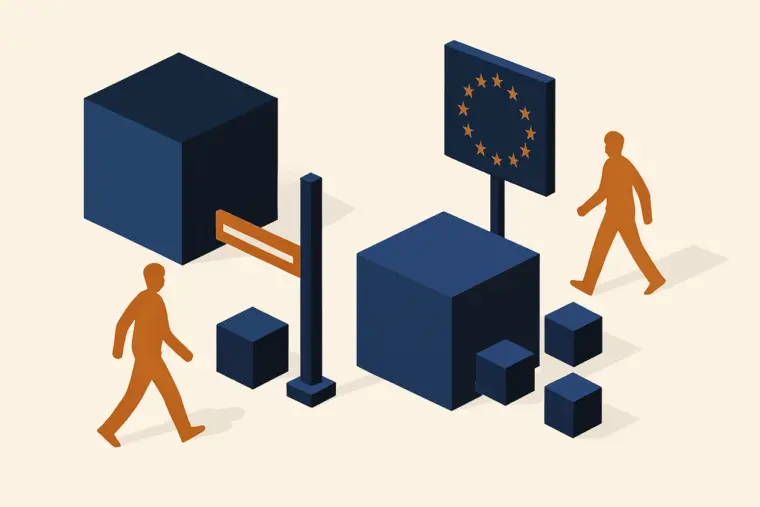
The European Union’s single market is often described in shorthand as “free trade among 27 countries,” but that phrase badly undersells it. A free-trade area removes tariffs. The single market goes much further: it tries to make 27 national economies behave, for commercial purposes, like one. A toy made in Portugal can be sold in Finland without a second safety certification; a Spanish architect can offer services in Ireland; a German saver can hold a French bank account; a Polish nurse can work in the Netherlands. Each of those is a deliberate construction, and together they form one of the most consequential economic projects in modern history.
The architecture rests on a famous formula known as the “four freedoms” — the free movement of goods, services, capital, and people. They sound simple. Making them real, across countries with different languages, legal traditions, and standards, has been the work of decades and remains contested. Understanding how the four freedoms actually operate explains both the market’s power and why slicing off just one of them is so politically fraught.
Beyond tariffs: what “single” really means
To grasp the single market, start with what it is not. It is not merely the absence of customs duties among members, though that exists. The deeper achievement is the removal of non-tariff barriers — the divergent product standards, professional-qualification rules, and regulatory requirements that quietly fragment markets even when tariffs are zero.
Two mechanisms do this work. The first is harmonisation: agreeing common EU-wide rules so a product or service meets one standard valid everywhere. The second is mutual recognition: where rules are not harmonised, a good or qualification lawfully accepted in one member state must generally be accepted in the others. Together they mean a business can design for a market of hundreds of millions rather than for 27 separate national rulebooks.
This is why economists treat the single market as a regulatory project as much as a trade one. The genuinely difficult part is not lowering prices at the border; it is agreeing on shared standards behind it. For how rule-making shapes whole industries, our economic-analysis coverage follows the same dynamic across the global economy.
The four freedoms, and why they travel together
The free movement of goods is the most familiar freedom: products that meet EU requirements can circulate without repeated checks or certifications. The free movement of capital lets money, investment, and financial services flow across borders, allowing savings in one country to fund projects in another. The free movement of services permits firms and professionals to offer their work across member states, though services — being intangible and often regulated nationally — remain harder to integrate fully than goods.
The free movement of people allows EU citizens to live, work, and study in other member states, a freedom that is economic and personal at once. According to the European Commission, these four freedoms are treated as an interlocking whole rather than a menu, and that indivisibility is a core political principle of the Union.
That principle has real consequences. When countries outside the EU seek access to the single market, they typically discover that the bloc resists granting one freedom — say, for goods — without the accompanying obligations, including free movement of people and acceptance of common rules. The freedoms are bundled by design, which makes “cherry-picking” the parts a country likes and rejecting the rest very difficult to negotiate.
The institutions that keep the field level
A market this integrated needs a referee, because free movement only works if everyone plays by the same rules and no member tilts the field. The EU therefore pairs the four freedoms with common competition policy, state-aid rules that limit how governments can subsidise their own firms, and oversight bodies that enforce the framework. The single currency, the euro, used by many but not all members, deepens integration further by removing exchange-rate friction within the eurozone — an area watched closely by the European Central Bank.
This shared regulatory and competition architecture is what distinguishes the single market from a looser trade pact. It is also what makes membership demanding: joining means accepting common rules and external oversight, not just enjoying open access. For how regulation and technology intersect across the bloc, see our digital-policy coverage.
Strengths, strains, and unfinished work
The single market has made the EU one of the world’s largest integrated economic spaces and a global standard-setter, since rules written for hundreds of millions of consumers often become de facto international norms. Yet it is unfinished. Integration in services and digital markets lags well behind goods, and barriers persist that fragment Europe’s economy and, many analysts argue, hold back its productivity and scale relative to other large markets.
Completing the market — deepening services, capital, energy, and digital integration — is a recurring policy ambition precisely because the gains are real but the political work of harmonising sensitive sectors is hard. Every step forward requires members to cede a little more national discretion in exchange for a larger shared market.
What is at stake
The single market is the economic heart of European integration, and its depth is what gives the EU global weight as a market and a rule-maker. Its central tension is permanent: the benefits of integration require shared rules and pooled authority, which sit uneasily with national sovereignty. Each debate over completing or constraining the market is, at bottom, a debate over that trade-off.
For the wider world, the single market is also a live demonstration of how far economic integration can go among sovereign states — and where it meets resistance. For more on global trade architecture, explore our world coverage and learn about Cubed News. The four freedoms remain both the Union’s greatest economic achievement and its most demanding ongoing project.
Frequently Asked Questions
What are the four freedoms of the EU single market?
The four freedoms are the free movement of goods, services, capital and people across the 27 member states. Together they aim to make national economies behave, for commercial purposes, like one integrated market.
How is the single market different from a free-trade area?
A free-trade area simply removes tariffs among members. The single market goes much further by removing non-tariff barriers such as divergent product standards and professional-qualification rules, integrating regulation itself so businesses can design for one market of hundreds of millions.
What is the difference between harmonisation and mutual recognition?
Harmonisation means agreeing common EU-wide rules so a product or service meets one standard valid everywhere. Mutual recognition applies where rules are not harmonised: a good or qualification lawfully accepted in one member state must generally be accepted in the others.
Why is it hard to take just one of the four freedoms?
The freedoms are designed to travel together, which is why slicing off a single one is politically fraught. The market's power comes from integrating goods, services, capital and people as a package rather than treating each in isolation.