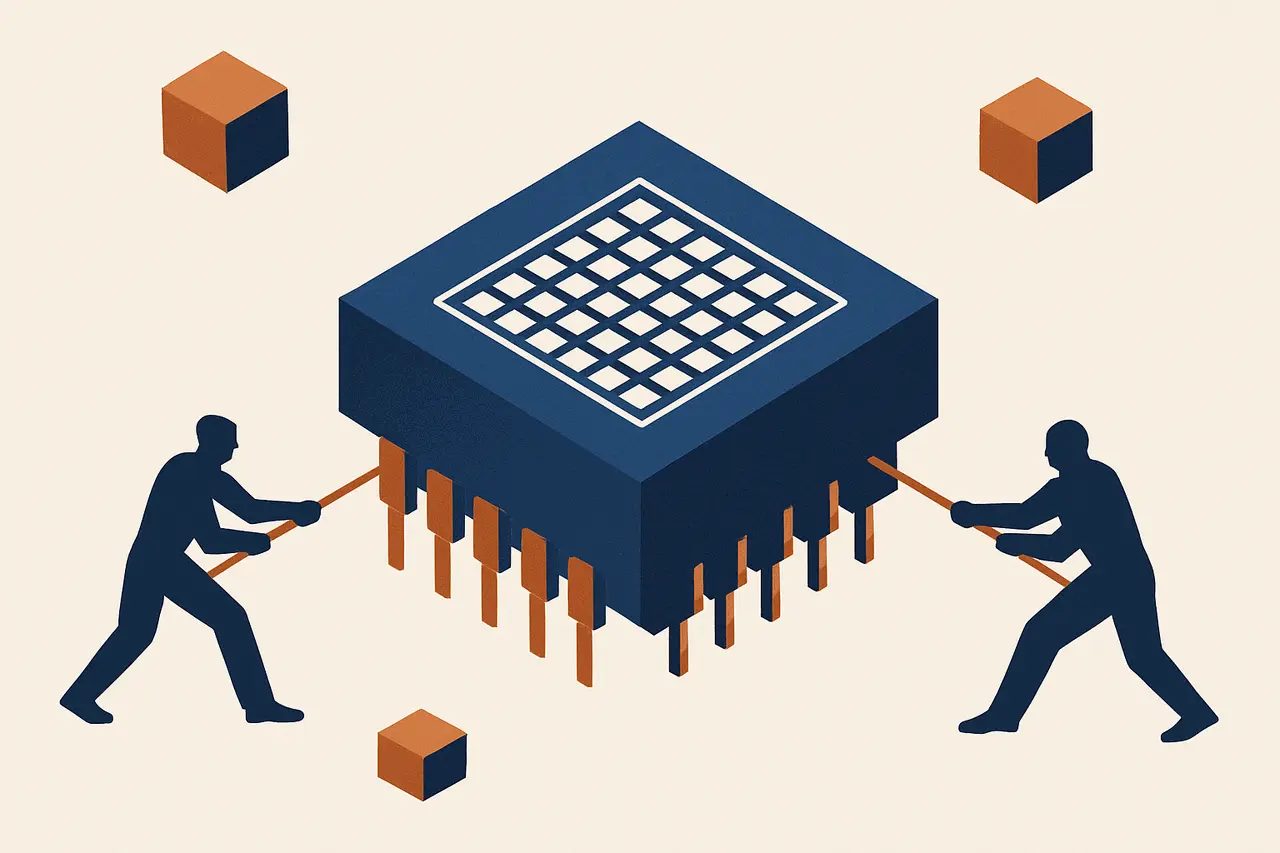
Almost every consequential technology of the age — artificial intelligence, smartphones, advanced weapons, modern cars, data centres — depends on the same hidden ingredient: advanced semiconductors, the tiny chips that do the computing. What few people appreciate is how astonishingly narrow the supply of the most advanced ones is. The cutting edge of the most important industry on earth rests on a chain so specialised that its critical links are held by a mere handful of companies in a mere handful of places. That concentration is the reason chips have become the most fraught choke point in geopolitics.
This is not a story about a commodity in short supply. It is a story about extreme specialisation, and about what happens when something indispensable can be made in only one or two locations. The dynamics reverberate across the global economy and increasingly across diplomacy itself.
A Supply Chain Like No Other
Making a leading-edge chip is arguably the most complex manufacturing humans have ever achieved, and the difficulty itself produces the concentration. The process involves printing patterns billionths of a metre wide onto silicon, in hundreds of precise steps, in facilities that cost staggering sums to build and run.
Two choke points stand out. The first is the machinery. To print the smallest, most advanced transistors, manufacturers need extreme ultraviolet lithography machines — devices of almost unbelievable complexity, each assembled from components sourced worldwide. At the frontier, these machines come from essentially a single company, based in the Netherlands. Without its equipment, the most advanced chips cannot currently be made at all.
The second is the manufacturing itself. Turning a chip design into physical silicon at the cutting edge is dominated by a small number of contract manufacturers, with one company in Taiwan holding a commanding share of the most advanced production. Many of the world’s leading chip designers do not own factories; they rely on this handful of manufacturers to build what they design. Layered on top are other specialised suppliers — of ultra-pure materials, design software and packaging — each with its own concentrations. The chain is a marvel of efficiency, but its very optimisation is what makes it brittle, a tension that recurs across technology supply chains but reaches its extreme here.
Why Concentration Became Confrontation
For decades this arrangement was treated as a triumph of globalised specialisation: each part of the world did what it did best, and everyone benefited from cheaper, better chips. In recent years that benign reading has given way to a security one, and the shift explains much of today’s tension.
Governments came to see that whoever controls the choke points controls access to a technology underpinning economic and military power. A nation that cannot obtain advanced chips cannot field the most capable artificial intelligence, the most advanced weapons, or the most competitive industries. Dependence on a distant supplier, once a feature, started to look like a vulnerability.
That reframing turned the supply chain into both a weapon and a target. The leading position of one Taiwanese manufacturer, on an island subject to geopolitical tension, means a significant share of the world’s most advanced chip production sits in a single, strategically exposed location — a concentration risk with few parallels in any other industry. Policymakers across the major powers increasingly describe semiconductors in the same breath as energy security, because an interruption at the frontier would ripple through every advanced economy at once.
Export Controls and the Subsidy Race
Faced with these realities, governments have moved on two fronts, and the limits of each reveal how hard the problem is.
The first is restriction. Recognising that the choke points can be used as leverage, some governments have imposed export controls designed to deny rivals access to the most advanced chips and the equipment to make them. Because the critical tools and technologies originate in just a few jurisdictions, coordinated controls among those countries can be remarkably potent — a small number of states can, in effect, gate the frontier of the technology. The US Department of Commerce and allied governments have made such measures a central plank of technology policy.
The second is construction. Major economies have committed large public subsidies to building domestic chip-manufacturing capacity, seeking to reduce reliance on distant choke points. Initiatives in the United States, the European Union and elsewhere reflect a shared determination not to be dependent on a single foreign source for something so vital. Yet the economics are punishing: leading-edge factories require enormous capital, scarce specialised talent, and years to build, and the underlying expertise cannot be conjured quickly. The supply chain that took decades to concentrate cannot be diversified overnight, however much money is thrown at it — a sobering reality that bodies tracking trade and industrial policy, including the World Trade Organization, have noted as these interventions multiply.
What’s at Stake
The stakes are about as high as economic policy gets. Semiconductors are a foundational technology, and control over their most advanced forms shapes the balance of economic and military power for decades. A disruption at the frontier — whether from conflict, natural disaster or deliberate restriction — would not dent one industry but stall progress across nearly all of them simultaneously, given how universal the dependence has become.
What comes next is a slow, expensive and uncertain effort to make the supply chain more resilient without sacrificing the efficiency that made advanced chips affordable in the first place. Some duplication of capacity is likely, at real cost, in the name of security. The tension between economic logic, which favours concentration, and strategic logic, which fears it, will not be resolved soon. For now, the most important industry in the world remains balanced on a handful of irreplaceable points — and everyone who depends on computing, which is to say everyone, has a stake in how that balance holds.
Sources
Related from Technology
What Is Edge Computing, and Why It Is Reshaping the Cloud
For two decades the trend was to centralise computing in vast distant data centres. Edge computing pushes some of it back out…
What Data-Localization Laws Do, and Why They Are Spreading
A growing number of countries now require that certain data about their citizens be stored or processed within their borders. The motives…

The Economics of Cloud Lock-In, and How It Happens
Moving to the cloud was sold as freedom from owning hardware. For many organisations it has quietly become a new kind of…
Get Cubed News in your inbox
Daily premium coverage, free. Independent · Source-cited.