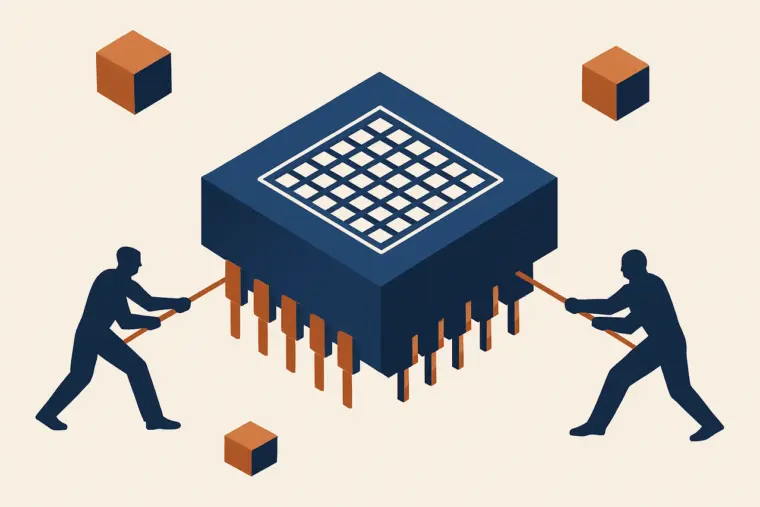
A semiconductor is a material, most commonly silicon, that conducts electricity better than an insulator such as glass but not as well as a metal such as copper, and whose conductivity can be precisely controlled. That controllability is the whole point: under some conditions a semiconductor carries current, and under others it resists it, which lets engineers use it as an electrical switch. Those switches, built in their billions, are what make modern electronics possible.
The same word is used for both the raw material and, loosely, for the chips made from it, which can cause confusion. Understanding how a plain element like silicon becomes a controllable switch explains why these components sit at the heart of nearly every device you own.
What makes a material a semiconductor?
A material is a semiconductor when its ability to conduct electricity falls between that of a conductor and an insulator and can be changed on demand. Pure silicon on its own is not especially useful; its usefulness comes from how readily its electrical behaviour can be tuned.
This middle position is what separates semiconductors from ordinary materials. A copper wire always conducts and a glass rod almost never does, but a semiconductor can be pushed either way. Engineers exploit that flexibility to make components that turn current on and off, which is the basis of digital logic.
How does doping turn silicon into a switch?
Doping turns silicon into a controllable material by deliberately adding tiny amounts of other elements to change how it carries charge. Introducing foreign atoms into the silicon crystal alters its conductivity in precise, predictable ways, creating two complementary types of material.
Adding an element with an extra outer electron, such as phosphorus, produces n-type silicon, which has spare mobile electrons available to carry current. Adding an element with one fewer, such as boron, produces p-type silicon, which effectively has gaps, or holes, where electrons are missing. Placing n-type and p-type regions next to each other creates junctions where the flow of current can be governed, which is the foundation of every semiconductor device.
What is a transistor, and what is a chip?
A transistor is a semiconductor device built from doped regions that acts as an electrical switch or amplifier, turning current on and off or boosting a signal. It works in much the same way as flipping a light switch, except it is microscopic and can operate billions of times a second with no moving parts.
A chip, or integrated circuit, is a small slice of silicon with enormous numbers of these transistors and their connections laid out on it in precise patterns. By arranging transistors to switch each other, engineers build the logic that lets devices process, store, and move information. A modern processor packs billions of transistors onto a piece of silicon smaller than a fingernail.
Conductor vs. insulator vs. semiconductor
The clearest way to place a semiconductor is against the two extremes it sits between. The table below compares the three categories.
| Material type | Conducts electricity? | Example | Typical role |
|---|---|---|---|
| Conductor | Yes, easily and always | Copper, aluminium | Carrying current, such as wires |
| Insulator | No, resists strongly | Glass, rubber | Blocking current, such as coatings |
| Semiconductor | In between, and controllable | Silicon | Switching current on and off in chips |
The decisive advantage of the semiconductor is the middle column. Because its conductivity can be switched, it can act as both a conductor and an insulator depending on the signal applied, which is exactly what a switch needs to do. Conductors and insulators are fixed in their behaviour; semiconductors are not.
Why do semiconductors matter?
Semiconductors matter because they are the building blocks of virtually all modern electronics and, with them, the digital economy. Smartphones, computers, cars, medical equipment, defence systems, and the data centres behind the internet all depend on chips to process and store information and manage power.
Their importance has grown alongside the industry itself, with global semiconductor sales rising from about 139 billion dollars in 2001 to 526 billion dollars in 2023, according to the Semiconductor Industry Association. Because chips are embedded in so many products across so many sectors, from cars to appliances to communications gear, their design and manufacture have become strategically important to governments as well as companies. When chip supply is disrupted, the effects ripple across the whole economy.
How are chips manufactured?
Chips are manufactured by building up and patterning many microscopic layers on a thin slice of silicon called a wafer. The process starts with highly purified silicon formed into a cylinder and sliced into wafers, onto which the transistor patterns are transferred, layer by layer, through a repeated cycle of deposition, patterning, and etching.
The patterning step relies on photolithography, which uses light to print circuit designs onto the wafer with extraordinary precision, since features are now measured in billionths of a metre. The work must take place in ultra-clean facilities, because a single speck of dust can ruin a chip. This difficulty is one reason advanced chipmaking is concentrated in a small number of enormously expensive factories, known as fabs.
Why is the chip supply chain so concentrated?
The chip supply chain is highly concentrated because building leading-edge fabrication plants requires vast capital, deep expertise, and specialised equipment that only a few firms in the world can supply. A single advanced fab can cost many billions of dollars and take years to build, which limits how many companies and countries can compete at the cutting edge.
The result is a global network in which design, manufacturing, and specialised tooling are spread across different companies and regions, each dependent on the others. That interdependence delivers remarkable efficiency but also fragility: a disruption at one critical link, whether a natural disaster, an export restriction, or a shortage, can slow production of countless finished goods. This is why semiconductors have become a matter of economic and national security strategy, not just engineering.
A further complication is that the industry is split into specialised roles. Some companies only design chips, some only manufacture them for others, and some only make the equipment or materials the factories depend on. A finished chip may be designed in one country, built in another, and packaged and tested in a third before it reaches a product, so the true supply chain stretches across the world.
The bottom line
A semiconductor is a material whose conductivity can be precisely controlled, and that single property, refined through doping into switches called transistors, underlies all digital technology. Packed by the billions onto chips, transistors give devices the ability to compute, remember, and communicate. That is why a substance most people never see directly has become one of the most consequential materials of the modern age.
Frequently Asked Questions
What is a semiconductor in simple terms?
It is a material, usually silicon, that sits between a conductor and an insulator and whose ability to carry electricity can be switched on or off. That switching is what makes it useful in electronics.
Why is silicon used for chips?
Silicon conducts electricity in a controllable middle range and its properties can be finely tuned through doping. It is also abundant and well understood, which makes it the standard material for chips.
What is the difference between a semiconductor and a chip?
A semiconductor is the material and its controllable behaviour. A chip, or integrated circuit, is a manufactured slice of silicon holding billions of transistors made from that material.
What does doping do?
Doping adds small amounts of other elements to silicon to control how it carries charge, creating n-type material with spare electrons and p-type material with electron holes. Their junctions form the basis of transistors.
Why are semiconductors considered strategically important?
Because they are embedded in nearly every modern product and industry, disruptions to chip supply ripple across the economy, making their design and manufacture a priority for companies and governments alike.