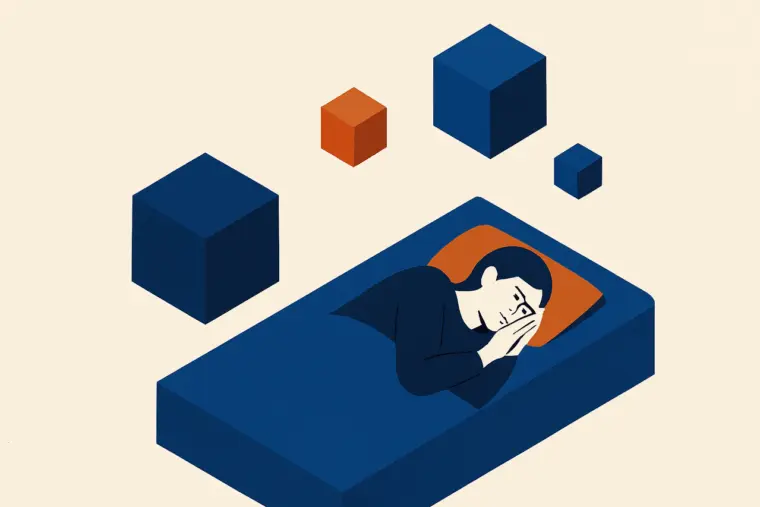
REM sleep, short for rapid eye movement sleep, is the stage of sleep in which the eyes dart rapidly beneath closed lids, the brain becomes nearly as active as it is when awake, and the most vivid dreams take place. It is one of two broad kinds of sleep the brain cycles through each night, and despite the busy brain activity, the body’s large muscles are briefly switched off. What follows is a plain-English guide to what REM is, how it fits into the sleep cycle and why it matters. It is general information about sleep, not medical advice.
What does REM sleep mean?
REM sleep is defined by the rapid, jerking movements of the eyes that give the stage its name. It was first identified in the 1950s by researchers who noticed these eye movements, along with brain-wave patterns that looked strikingly like wakefulness, in sleeping volunteers.
The defining features are a fast, low-amplitude brain-wave pattern, the darting eyes, and a near-total loss of tone in the voluntary muscles. Because the brain is so active while the body is still, REM is sometimes called paradoxical sleep.
How does REM fit into the sleep cycle?
Sleep is not a single flat state but a repeating cycle that alternates between non-REM and REM stages. Non-REM sleep is divided into three stages, usually labelled N1, N2 and N3, that run from the lightest drowsiness to the deepest slow-wave sleep, after which the brain enters REM.
A full cycle lasts roughly 90 minutes, and a typical night contains four to six of them. The balance shifts as the night wears on: early cycles are heavy on deep non-REM sleep, while later cycles contain progressively longer REM periods. That is why the richest dreaming often comes in the hours before waking, and why losing the final stretch of sleep removes a large share of REM.
What is the difference between REM and deep sleep?
The key distinction most people are really asking about is REM versus deep sleep, and they are not the same thing. Deep sleep is a non-REM stage, the N3 stage, characterised by slow delta brain waves, a slow heartbeat and slow breathing, and it is when much of the body’s physical restoration is thought to happen. REM, by contrast, is marked by fast brain activity and vivid mental experience.
| Feature | REM sleep | Deep (N3) sleep |
|---|---|---|
| Brain waves | Fast, near-awake pattern | Slow delta waves |
| Dreaming | Vivid, story-like dreams common | Dreams rare and vague |
| Muscles | Voluntary muscles paralysed | Muscles relaxed but not paralysed |
| Main role | Memory, learning, emotional processing | Physical restoration and recovery |
| Timing | More in the second half of the night | More in the first half of the night |
Both stages are necessary, and a healthy night includes several rounds of each. Thinking of one as good sleep and the other as lesser sleep misreads how the system works.
Why is the body paralysed during REM?
During REM the brain actively suppresses signals to most voluntary muscles, producing a temporary paralysis known as atonia. The widely accepted explanation is that this stops the sleeper from physically acting out the vivid dreams unfolding in the mind.
The muscles that keep a person alive are exempt: the heart keeps beating and the diaphragm keeps the breath going. When this switch does not work properly, people can move or speak during dreams, a pattern doctors recognise as a sleep disorder rather than a normal event.
Why does REM sleep matter?
REM sleep matters because it appears central to how the brain processes information and emotion. During REM the brain is thought to consolidate memories, strengthening the neural connections that turn the day’s experiences into lasting knowledge and skills.
REM also seems to help with emotional regulation. Regions involved in processing feelings, including the amygdala, are highly active during REM, and researchers link the stage to sorting through and defusing emotional experiences. People deprived of REM often report feeling foggy, irritable and less able to concentrate.
Sleep is as essential to survival as food and water; without enough of it the brain struggles to form and maintain the pathways that let us learn and remember.
Researchers still debate exactly why REM does what it does, and no single theory explains every finding. What the evidence consistently shows is that both REM and deep sleep contribute to healthy brain function, so the practical takeaway is to get enough total sleep rather than to chase one stage at the expense of another.
How much REM sleep do people need?
In healthy adults, REM makes up roughly 20 to 25 percent of total sleep time, which for a typical night works out to somewhere around 90 minutes to two hours spread across several cycles. There is no need to count REM minute by minute; getting enough total sleep on a regular schedule is what allows the stages to fall into place.
The proportion changes dramatically over a lifetime. Newborns spend about half their sleep in REM, a share that is thought to support the rapid development of the brain, and the figure falls through childhood toward the adult level. Because alcohol and some medicines can suppress REM, sleep can be less restorative even when its length looks normal.
What disrupts REM sleep?
Several everyday factors chip away at REM without a person realising it. Alcohol is a notable one: it can help people fall asleep faster but tends to suppress REM in the first part of the night, which is one reason sleep after drinking often feels unrefreshing.
Cutting sleep short is the biggest disruptor, because the longest REM periods sit at the end of the night, so an early alarm shaves off REM out of proportion to the hours lost. Irregular schedules, including shift work and jet lag, scramble the timing of the cycle, and some medications, including certain antidepressants, are known to reduce REM as well. Even a single night of very poor sleep can prompt a rebound, with the brain spending extra time in REM the following night as if catching up.
How can you support healthy REM sleep?
The most reliable way to protect REM is to protect sleep as a whole, since the stages arrange themselves automatically across a full night. A consistent bedtime and wake time, a dark and cool room, and limiting alcohol and heavy late meals all help the cycles run their course.
Cutting sleep short is the surest way to lose REM, because the longest REM periods come near the end of the night. Persistent trouble sleeping, loud snoring or acting out dreams are worth raising with a clinician rather than self-treating.
The bottom line
REM sleep is the vivid-dreaming, near-awake stage in which the brain is busy while the body lies still, and it works in partnership with the quieter deep-sleep stages rather than competing with them. It underpins memory, learning and emotional balance, and the best way to get enough of it is simply to give sleep the time and consistency it needs.
Frequently Asked Questions
Is REM sleep the same as deep sleep?
No. Deep sleep is a non-REM stage marked by slow delta brain waves and physical recovery. REM is a separate stage with fast, near-awake brain activity and vivid dreams. Both occur in every night's sleep but serve different roles.
What happens if you don't get enough REM sleep?
Short-term, people may feel groggy and find it harder to concentrate and regulate mood. Research links ongoing REM shortfall to problems with memory and emotional processing. This is general information, not medical advice; persistent sleep problems are worth discussing with a clinician.
Why is the body paralysed during REM?
The brain actively switches off most voluntary muscles during REM, a state called atonia. This is thought to stop people physically acting out their dreams. Breathing muscles and the heart keep working normally.
When during the night do you get the most REM?
REM periods lengthen as the night goes on, so most REM sleep occurs in the second half of the night and toward morning. Cutting sleep short therefore tends to remove a disproportionate amount of REM.
Do you only dream during REM sleep?
Most vivid, story-like dreams happen during REM, but dreaming can also occur in non-REM sleep, where dreams tend to be shorter and less vivid.