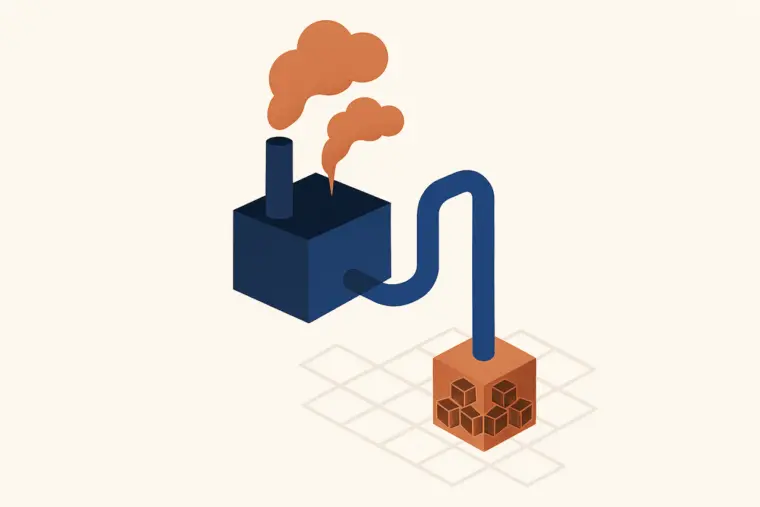
Entropy is a measure of how many different microscopic arrangements a system could be in while still looking the same from the outside — and, loosely, a measure of how spread out its energy has become and how little of that energy is still available to do useful work. It is one of the most important quantities in physics, because it sets the direction in which natural processes unfold. Heat flows from hot to cold, gases fill the room they are put in, and ice melts in a warm drink, all in obedience to entropy.
What is entropy in one plain sentence?
Entropy counts the number of ways the tiny parts of a system can be arranged without changing its overall appearance. A tidy deck of cards in perfect order has exactly one arrangement, so its entropy is low. A shuffled deck can be in any of a huge number of orders that all look equally messy, so its entropy is high.
Physicists put a number on this. The 19th-century physicist Ludwig Boltzmann showed that entropy is proportional to the logarithm of the number of microscopic arrangements, called microstates, that produce the same large-scale state. More microstates means more entropy.
Where did the idea come from?
The concept was introduced by the German physicist Rudolf Clausius in 1865, working on how steam engines convert heat into motion. He coined the word entropy to describe a quantity that tends to grow whenever energy is transformed.
Clausius approached it from the outside, tracking heat moving in and out of engines. Boltzmann later gave it a microscopic meaning, connecting that same quantity to the countless positions and speeds of individual molecules. Both descriptions turn out to measure the same thing.
What does entropy have to do with the second law of thermodynamics?
The second law of thermodynamics states that the total entropy of an isolated system never decreases; it either stays the same or increases over time. This is why some processes only ever run one way.
A hot cup of coffee cools to room temperature, but a room-temperature cup never spontaneously heats itself by pulling warmth out of the air. Both directions would conserve energy, so the first law of thermodynamics allows either. It is the second law, and rising entropy, that rules out the reverse.
Because of this one-way behaviour, entropy is sometimes called the arrow of time. It gives past and future a physical difference: the future is the direction in which entropy is higher.
How is entropy in physics different from “entropy” in everyday speech?
In casual use, entropy has become a synonym for chaos, decay, or things falling apart. The physics meaning is narrower and more precise, and the two can point in opposite directions.
| Everyday “entropy” | Entropy in physics |
|---|---|
| A loose metaphor for mess or decline | A precise, measurable quantity with units of energy per temperature |
| Suggests things simply break down | Describes how energy and matter spread among available arrangements |
| Implies disorder is always visible chaos | Order can increase locally as long as total entropy rises elsewhere |
| Has no formula | Defined by Boltzmann’s relation linking entropy to microstate counts |
The word “disorder” is a useful first picture, but it can mislead. A better intuition is spreading out: entropy rises when energy or particles have more ways to be distributed.
Why does entropy tend to increase?
Entropy tends to increase because high-entropy states are overwhelmingly more likely than low-entropy ones. It is not that nature prefers mess; it is that there are vastly more messy arrangements than tidy ones.
Imagine dropping a jigsaw puzzle. There is only one way for every piece to land assembled, but astronomically many ways for the pieces to scatter. Randomness almost always produces a scattered result simply because scattered results outnumber neat ones by a colossal margin.
The same logic applies to molecules. When a drop of ink spreads through water, the mixed state can be realised in far more molecular arrangements than the concentrated drop, so mixing is what we almost always observe.
Can entropy ever decrease?
Entropy can decrease in one place, but only if it increases by at least as much somewhere else. A refrigerator lowers the entropy of the food inside by removing heat, yet it dumps even more entropy into the kitchen through its warm exhaust and the electricity it consumes.
Living things are a striking example. A growing organism builds highly ordered structures, lowering its internal entropy, but it does so by consuming food and releasing heat and waste, raising the entropy of its surroundings. There is no violation of the second law, only local order paid for by a larger global increase.
How is entropy measured?
Entropy is a physical quantity with real units, measured in joules per kelvin, which is energy divided by temperature. This reflects its origins in the study of heat: adding heat to a system at a given temperature raises its entropy by a calculable amount.
At the molecular level, Boltzmann’s approach gives the same quantity a different form, expressing entropy in terms of the number of microstates through a simple logarithmic relationship. The two definitions agree, which is one of the deep unifying results of physics. A perfectly ordered crystal at absolute zero, the coldest possible temperature, would in principle have zero entropy, a statement known as the third law of thermodynamics.
What are common misconceptions about entropy?
The biggest misconception is that entropy proves order cannot arise naturally. In fact, ordered structures form all the time, from snowflakes to galaxies to living organisms, because the second law only requires that total entropy rises, not that entropy rises everywhere at once.
Another misconception is that entropy is simply a measure of visible untidiness. Two glasses of water at different temperatures may look identical, yet mixing them increases entropy even though nothing looks messier. Entropy tracks the spreading of energy and the counting of arrangements, which do not always match a casual sense of neatness.
Does entropy mean the universe is doomed?
Rising entropy has led to a long-discussed idea called the heat death of the universe, a hypothetical far-future state in which energy is so evenly spread that no useful work can be extracted anywhere. This remains a theoretical projection about timescales far beyond human experience, not a near-term forecast.
For everyday purposes, the practical lesson of entropy is humbler. Every engine, power plant, and living cell loses some energy as unusable heat, which is why no machine can be perfectly efficient.
The bottom line
Entropy measures how many microscopic arrangements match a system’s overall state, and it captures the tendency of energy to spread out and become less available for work. The second law of thermodynamics, which says total entropy never decreases, explains why heat flows one way, why perpetual-motion machines are impossible, and why time seems to have a direction. Order can still emerge locally, from crystals to living beings, as long as a larger disorder is created to pay for it.
Frequently Asked Questions
Is entropy the same as disorder?
Disorder is a useful first picture, but the precise meaning is the number of microscopic arrangements that match a system's overall state. A clearer intuition is that entropy measures how spread out energy and matter can become. Order can even increase locally as long as total entropy rises overall.
Who discovered entropy?
Rudolf Clausius introduced the term in 1865 while studying how heat engines turn warmth into motion. Ludwig Boltzmann later connected it to the statistical behaviour of molecules, showing entropy is proportional to the logarithm of the number of possible microscopic arrangements.
Does entropy always increase?
The total entropy of an isolated system never decreases, according to the second law of thermodynamics. It can decrease in one place, such as inside a freezer, but only if it increases by at least as much in the surroundings.
What is the arrow of time?
The arrow of time is the idea that the direction of increasing entropy defines the difference between past and future. Many physical laws work the same forwards and backwards, but rising entropy singles out one direction as the future.
Why can't any engine be 100% efficient?
Every energy conversion produces some waste heat that spreads out and cannot be fully recovered as useful work. This unavoidable increase in entropy sets a hard limit on efficiency for engines, power plants, and other machines.