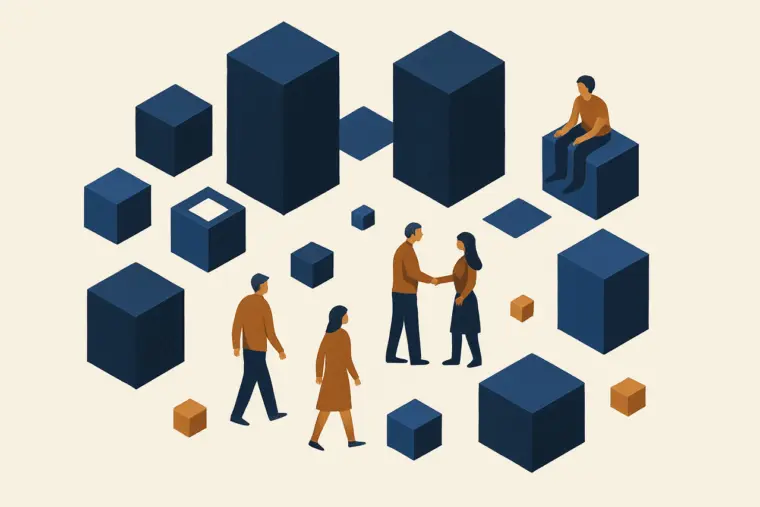
Soft skills are the interpersonal, behavioural and cognitive abilities that enable people to work well with others and manage their own work effectively. They include qualities such as communication, teamwork, problem-solving and adaptability. A useful shorthand is that hard skills describe what you do, while soft skills describe how you do it, which is why employers increasingly look for both when hiring and promoting.
What exactly counts as a soft skill?
Soft skills are the personal and social qualities that shape how someone approaches their work and interacts with colleagues, customers and clients. Unlike knowledge of a specific tool or subject, they are broadly transferable, applying across almost any role or industry. They cover how a person communicates, collaborates, solves problems, handles pressure and adapts to change.
Because they arise from personality, habits and experience rather than a single qualification, soft skills are sometimes called people skills, interpersonal skills or professional skills. They are not tied to one job, which is part of what makes them so valuable across a career.
How do soft skills differ from hard skills?
Hard skills are technical, teachable abilities needed to carry out specific tasks. Examples include proficiency in a programming language, building financial models in a spreadsheet, or using design software. These skills are usually measurable and can be demonstrated through a test, a portfolio or a certificate.
Soft skills, by contrast, reflect a person’s approach to work and to being part of a team. They are harder to quantify because they stem from personality traits and accumulated experience. This difference also affects hiring: a hard skill can often be verified directly, whereas soft skills are typically assessed through interviews, references and behavioural questions.
| Feature | Hard skills | Soft skills |
|---|---|---|
| What they describe | What you do (technical tasks) | How you do it (approach and behaviour) |
| Examples | Coding, accounting, data analysis | Communication, teamwork, adaptability |
| How they are learned | Formal training, courses, education | Experience, practice and feedback |
| How they are measured | Tests, certificates, portfolios | Interviews, references, observation |
| Transferability | Often role-specific | Broadly transferable across roles |
What are common examples of soft skills?
Some soft skills appear again and again on employers’ lists. Communication, the ability to share information clearly and listen well, is among the most valued. Teamwork and collaboration allow people to work effectively with others toward shared goals. Problem-solving involves analysing a situation and finding workable solutions, while adaptability is the capacity to adjust to new circumstances and change.
Other frequently cited examples include time management, leadership, emotional intelligence, critical thinking and conflict resolution. Employers consistently rank communication, problem-solving and adaptability highly, but the specific mix that matters most can vary by role and industry.
Can soft skills be developed?
Although soft skills are influenced by personality, they are not fixed. They can be strengthened over time through experience and deliberate practice. For example, someone can improve their communication by collaborating with different teams, or build resilience by working through difficult situations at work.
Because these skills develop through doing rather than through a single course, feedback plays an important role. Reflecting on how an interaction went, and adjusting for next time, is one of the main ways people grow their soft skills. This gradual, experience-based development is a key difference from many hard skills, which can often be learned more directly and more quickly through formal training and structured practice.
Why do employers value soft skills?
Technical ability alone rarely guarantees success in a role. Even highly skilled specialists need to communicate their work, cooperate with colleagues, handle setbacks and adapt as priorities change. Soft skills make these things possible, which is why employers place growing weight on them.
The most sought-after candidates usually combine both types of skill. Hard skills get the technical job done, while soft skills determine how smoothly a person works within a team and an organisation. This balance tends to lead to stronger overall performance, better teamwork and long-term professional growth, which is why job descriptions and interviews increasingly probe for both.
How are soft skills grouped?
Because the term covers so much ground, soft skills are often sorted into broad families. One family concerns communication and relationships, including listening, writing clearly, giving feedback and resolving conflict. A second concerns self-management, such as time management, organisation, reliability, self-motivation and resilience under pressure. A third concerns thinking and judgement, including problem-solving, critical thinking, decision-making and creativity.
These groups overlap in practice. Leading a project, for instance, draws on communication, self-management and problem-solving all at once. Grouping soft skills is mainly a way to make them easier to discuss and develop, rather than a strict classification, and different sources divide them in slightly different ways. What matters in practice is that these abilities work together, and that strengthening one, such as listening carefully, often improves others, such as teamwork and conflict resolution.
How can you show soft skills to an employer?
Because soft skills are harder to prove than a certificate or a test score, demonstrating them takes a different approach. Rather than simply listing traits, people are often advised to show soft skills through concrete examples: describing a situation, the action they took and the result. A claim to be a strong communicator carries more weight when paired with a specific instance of resolving a misunderstanding or explaining a complex idea clearly.
Employers, for their part, often try to assess soft skills through behavioural interview questions that ask candidates to describe how they handled real situations in the past. References and, in some cases, practical exercises or work trials can also give a sense of how someone actually behaves with others, which a written list of skills cannot fully capture.
Why soft skills matter more than ever
As workplaces change, driven by automation, remote collaboration and rapid shifts in technology, distinctly human abilities have become more prominent. Skills such as communication, adaptability, critical thinking and collaboration are difficult to automate and remain in demand across sectors. Major workforce studies repeatedly highlight these human-centred skills as priorities for the future of work.
Understanding what soft skills are, and how they differ from hard skills, helps individuals present themselves more fully to employers and helps organisations build effective teams. Rather than competing with technical expertise, soft skills complement it, shaping how knowledge and ability are actually put to use.
For individuals, the practical takeaway is that soft skills are worth cultivating deliberately, not left to chance. Because they develop through experience, seeking out situations that stretch communication, collaboration and problem-solving can pay off across an entire career, in a way that is less tied to any single job or technology than many hard skills are.
Frequently Asked Questions
What is the difference between soft skills and hard skills?
Hard skills are technical, teachable abilities needed to perform specific tasks, such as coding, accounting or operating software, and they are usually measurable. Soft skills are interpersonal and behavioural qualities, such as communication and teamwork. A common summary is that hard skills describe what you do, while soft skills describe how you do it.
What are common examples of soft skills?
Widely cited examples include communication, teamwork, problem-solving, adaptability, time management, leadership and emotional intelligence. Employers consistently value communication, problem-solving and adaptability in particular. These abilities apply across many roles and industries rather than being tied to one specific job.
Can soft skills be learned?
Yes. While soft skills are often shaped by personality and experience, they can be developed over time through practice and feedback. People typically strengthen them by working with different teams, taking on new challenges and reflecting on their interactions, rather than through a single course or certificate.
Why do employers care about soft skills?
Employers value soft skills because they affect teamwork, communication and how people handle change and problems. Technical ability alone does not guarantee that someone can collaborate, lead or adapt. A balance of soft and hard skills tends to lead to stronger performance, better teamwork and long-term professional growth.
Are soft skills harder to measure than hard skills?
Generally yes. Hard skills can often be tested directly, for example through a coding task or a certification exam. Soft skills stem from personality and experience, so they are harder to assess with traditional methods. Employers often gauge them through interviews, references and behavioural questions instead.