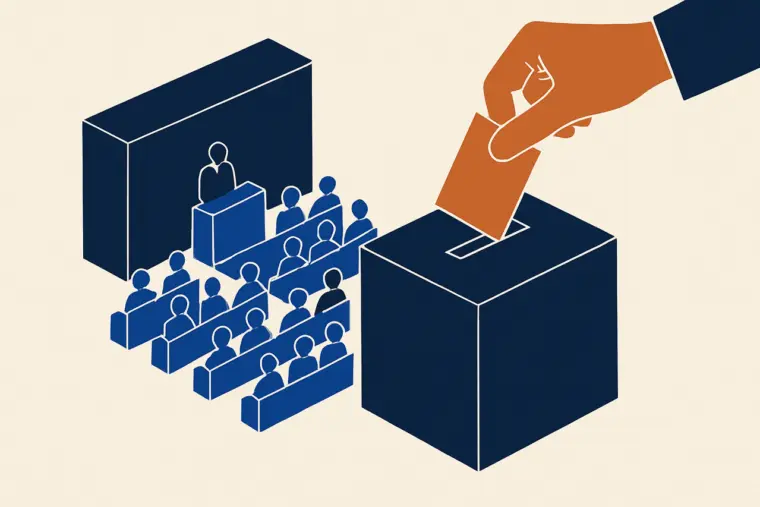
A caucus is a meeting of members or supporters of a political party who gather to choose which candidate to back and to select delegates for a nominating convention. In the context of United States presidential nominations, caucuses are local, in-person gatherings run by the parties themselves, in contrast to primaries, which are statewide elections run by governments. The word also has a second meaning: a caucus can refer to a group of legislators who share an interest or affiliation.
This explainer focuses on the nominating caucus, the kind that makes headlines early in a U.S. presidential race, and how it differs from a primary.
How does a caucus work?
In a caucus, supporters of a party gather at a set time and place to express their candidate preferences and elect delegates. Rather than casting a private ballot and leaving, participants take part in a meeting that can last hours and may involve discussion and persuasion.
Depending on the party and state, caucus-goers may show support by raising hands or by physically grouping together by candidate. In some Democratic caucuses, a candidate has needed to reach a threshold of support, such as 15 percent in a precinct, to be considered viable; supporters of nonviable candidates can then realign to another choice. The goal is to allocate delegates who will represent those preferences at higher-level conventions.
How is a caucus different from a primary?
The core difference is that a primary is a government-run election with secret ballots, while a caucus is a party-run meeting where preferences are expressed in person. That distinction drives most of the other differences between the two systems.
| Feature | Caucus | Primary |
|---|---|---|
| Run by | Political party | State or local government |
| Format | In-person meeting | Ballot-based election |
| Voting method | Show of hands or grouping; often public | Secret ballot |
| Time required | Can last hours | Usually minutes, over polling hours |
| Funding and oversight | Party-funded and party-run | Government-funded and regulated |
| Participation | Typically lower turnout | Typically higher turnout |
Because caucuses require attending a meeting at a fixed time, they tend to draw fewer, more committed participants, whereas primaries let people vote quickly during open polling hours.
Why do some places use caucuses and others primaries?
The choice between a caucus and a primary is made by parties and states, and it reflects tradition, cost, and party preference. Primaries are far more common because they are run and funded by governments and are easier for most people to take part in.
Caucuses are entirely controlled by the parties, with no government funding or oversight, which gives parties more say over the rules. In recent U.S. cycles the large majority of states have used primaries, with only a handful using caucuses. Iowa’s Democratic Party, long famous for its first-in-the-nation caucus, restructured its 2024 process, underscoring a broader move away from traditional caucuses.
What are the trade-offs of caucuses?
Supporters of caucuses argue they encourage grassroots participation, deliberation, and party-building, since neighbors gather and discuss candidates face to face. The format can reward organization and enthusiasm rather than simply name recognition.
Critics counter that caucuses are less accessible: requiring people to attend a lengthy evening meeting can exclude those who work, have caregiving duties, are ill, or cannot attend in person. That accessibility gap, along with the complexity of reporting results, is a major reason primaries have become the dominant method.
What is the other meaning of caucus?
Outside the nominating process, a caucus is a group of legislators who band together around a shared party, region, or cause. For example, members of a legislature may form a caucus to coordinate strategy or to advance a particular set of issues.
In this sense, “caucus” describes an organized bloc rather than an event. The two meanings are related by the idea of like-minded people meeting to act together, but they operate in different settings.
What are common misconceptions about caucuses?
A common misconception is that caucuses and primaries are the same thing with different names. They differ fundamentally: one is a party meeting, the other a government election with secret ballots.
Another is that caucuses are the main way U.S. nominees are chosen; in fact most states use primaries, and caucuses now cover only a small share of contests. A third is that caucus voting is always private, when in many caucuses participants reveal their preference openly by grouping or raising hands.
Why does the distinction matter?
The caucus-versus-primary distinction matters because the format can shape who participates and, in turn, which candidates gain early momentum. A process that rewards intense, organized support can produce different results than a quick secret-ballot vote open to a broader electorate.
Understanding the difference helps voters interpret early nominating results and the outsized attention that first contests often receive.
What is a delegate, and why do caucuses select them?
A delegate is a person chosen to represent local voters’ preferences at a party’s nominating convention, where the presidential nominee is formally selected. Both caucuses and primaries ultimately serve to allocate these delegates in line with candidate support.
In a caucus, participants elect delegates who advance through county and state conventions before the national one. The number of delegates a candidate wins, rather than the raw headcount at any single meeting, is what counts toward the nomination. This layered, delegate-based structure is a defining feature of the U.S. nominating process and applies whether a state uses a caucus or a primary.
Do early caucuses decide the nominee?
Early contests such as Iowa’s have historically drawn outsized attention, but they do not by themselves decide a nomination. They award only a small share of the total delegates.
Their main effect is on momentum, media coverage, and fundraising: a strong showing can lift a lesser-known candidate, while a weak one can end a campaign. Because the calendar and rules are set by the parties rather than fixed in law, the order and prominence of contests can change from cycle to cycle, as recent shifts in the Democratic schedule show.
For that reason, the results of early caucuses are often read as signals of viability as much as measures of delegate strength. Candidates and commentators watch not only who wins but by how much, and whether a campaign beat expectations. That interpretive weight, rather than the delegate math alone, is much of what gives the first contests their outsized reputation.
The bottom line
A caucus is a party-run, in-person meeting where supporters choose candidates and select delegates, distinct from a government-run primary election with secret ballots. Caucuses can foster deliberation but tend to have lower, less representative turnout, which is why most U.S. states now rely on primaries. The word can also describe a bloc of legislators organized around a common interest.
Frequently Asked Questions
What is a caucus in simple terms?
It is a party meeting where supporters gather in person to choose candidates and pick delegates for a nominating convention. It is run by the party, not the government.
How is a caucus different from a primary?
A caucus is a party-run, in-person meeting where preferences are often shown openly, while a primary is a government-run election with secret ballots that usually takes only minutes to vote in.
Why do most states use primaries?
Primaries are government-funded, easier to take part in, and typically draw higher turnout. Caucuses require attending a lengthy meeting, which limits participation.
Is caucus voting secret?
Often not. In many caucuses, participants reveal their preference openly by grouping together or raising hands, unlike the secret ballot used in primaries.
Does 'caucus' have another meaning?
Yes. It can also mean a group of legislators who organize around a shared party, region, or cause to coordinate strategy or advance issues.